







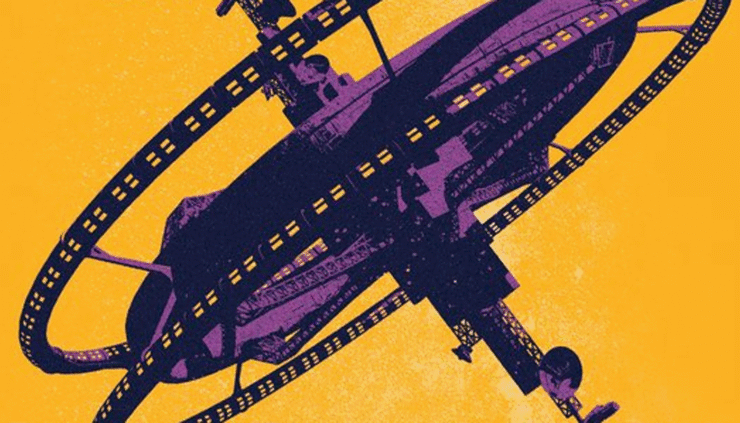
Habitat or planet? Fictional space colonists were once divided on the question.
On the one hand, even if we were to limit ourselves to somewhat Earth-like worlds, there may be a huge gap between “life-bearing” and “human compatible”1.
Space habitats, on the other hand, can be designed with the end user in mind and who knows? Might well be.
But… space habitats require significant upfront investment and continual upkeep, whereas Earth-like planets exist (presumably) and can support life for billions of years2.
Readers will notice most of the five works I am reviewing here were published roughly between the publication of Gerard K. O’Neill’s 1977 The High Frontier: Human Colonies in Space and the 1986 Challenger disaster. This isn’t a coincidence.
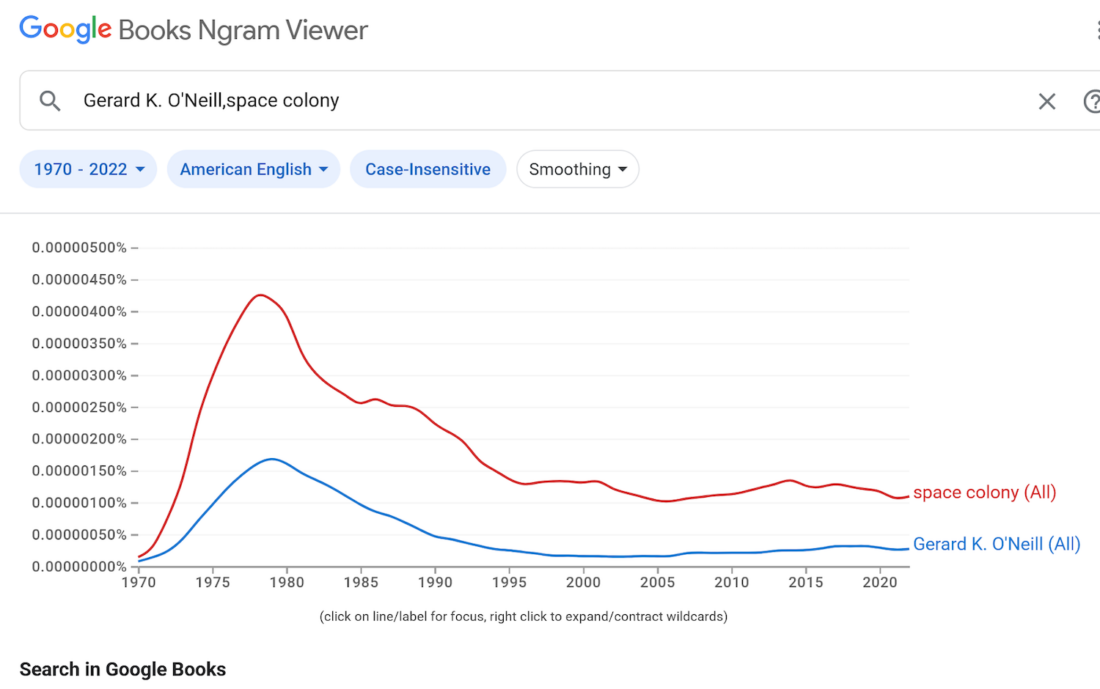
O’Neill did a good job of convincing people that space colonies were a near-future certainty, thanks to cheap, reliable access to space, courtesy of the space shuttle. The actual performance record of the shuttle suggested otherwise. Thus, the Ngram for Gerard K. O’Neill space colony looks like this:
So, here are the five SF works featuring habitats that I promised.
Downbelow Station by C.J. Cherryh (1981)
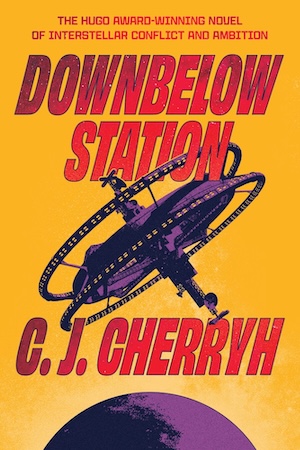
The Earth Company did not allow the apparent lack of habitable planets within sublight starship range to slow their ambitious program of interstellar colonization. Instead, they mandated the construction of vast orbiting stations in various promising systems. Even after the first life-bearing world was discovered, this policy continued… because (as previously mentioned) even a life-bearing world might not be particularly suitable for humans.
An unfortunate consequence of the above is that should war break out, as it did in the backstory to Downbelow Station, even impressively large space stations may be overwhelmed by waves of refugees fleeing warzones. Avoiding mass fatality events will require bold, decisive action.
I say this almost every time I mention an early Company War book: I have no idea what it was that was valuable enough to justify the initial sublight expansion. Still, it was a relief to read an SF novel in which the solution to waves of refugees wasn’t to kill the surplus population.
Helliconia Summer by Brian W. Aldiss (1983)
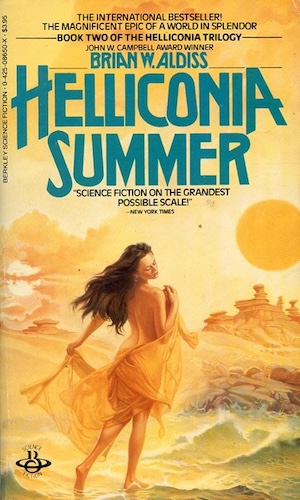
Earth went to the trouble of building and staffing the Avernus space station orbiting Helliconia for three reasons. Life-bearing worlds are rare enough to invite study. Because they are rare, life-bearing worlds are separated by distances too vast for routine commuting. Finally, Helliconia may be life-bearing, but among its life forms is a virus that swiftly kills any unprotected human. All of these add up to the need for an orbiting habitat to house human scientists.
In fact, Helliconia is so distant that no adult human made the trip. Earth sent robots and the means to create humans from in situ resources. Anyone born in Avernus will die in Avernus… except for a lucky few who are allowed to visit the surface for as long as it takes the virus to kill them. One such visitor will do his best to leave his mark on Helliconian history.
The Helliconia trilogy, of which Summer is the middle volume, is the big-picture view of the history over Helliconia’s surprisingly humanoid inhabitants over the course of a long climate cycle driven by Helliconia’s star’s eccentric orbit around a larger star. Human (and humanoid) happiness tends to be little-picture, so prospective readers should be aware that the overall effect is rather gloomy… as you might deduce from the fact that humans in Avernus compete for the chance to die horribly down on Helliconia.
Mallworld by S.P. Somtow (1984)
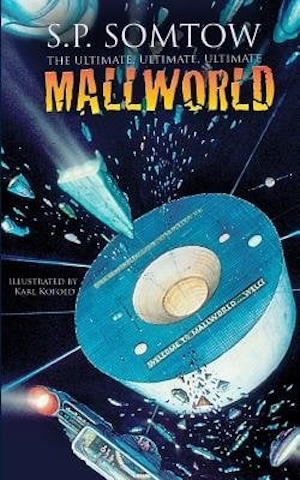
The highly advanced Selespridar were so impressed by humanity that they displaced the entire solar system (as far out as Neptune3) into another universe before humans could infest the galaxy. Humans will remain in their extradimensional bubble until they either mature or go extinct.
Whether humans will ever mature is an open question. What is clear is that they can build space habitats if that’s the only choice available. Among the thousands of habitats scattered across the Solar System is Mallworld. Mallworld embodies humanity’s most closely held values… which is to say, Mallworld is a temple to crass, unbounded commercialism.
There are a number of parallels between Mallworld and Avernus. Happily for the people trapped in Somtow’s Solar System, Mallworld is a comedy rather than a morose study of historical forces against which no individual can stand, so the book is nowhere near as depressing as the Helliconia trilogy.
Schismatrix by Bruce Sterling (1985)
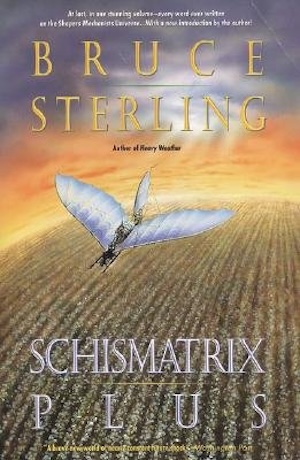
Advanced technology allows humans to transform the dead matter of the Solar System into a bewildering number of habitats. This would surely be enough to support a vast assortment of extremely diverse off-world cultures. But humans did what humans always do: found a flimsy pretext to divide themselves into a few factions before launching bloody strife.
Abelard Lindsay and his friends fancy themselves bold political visionaries who will reshape human society according to Abelard et al.’s perfectly sensible, clearly superior political philosophy. Victory should be assured! Actual results are somewhat mixed, but Abelard does, at least, get to have many diverting adventures over the course of his life.
Ah, student activists. They mean well.
Diplomatic Immunity by Lois McMaster Bujold (2002)
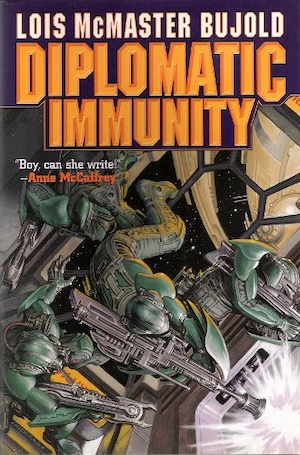
Quaddies were genetically engineered to provide a workforce who could work in freefall, ideally without the bother of wages or human rights. The Quaddies opted to decamp en masse to found their own society. Their modified anatomy made them unsuitable for planetary life. Therefore, Quaddies live in habitats such as Graf Station.
Although Barrayar is not known for its enthusiastic embrace of diverse body types, preferring to euthanize anything that looks like it might be a mutant, Barrayar does have diplomatic relations with the Quaddies. Miles Vorkosigan, himself a frequent target for Barrayaran prejudice, is the lucky Barrayaran tapped to deal with the Graf Station crisis…a crisis that quickly escalates.
Miles belongs to a very particular class of special agent, the sort in whose wake chaos follows. See also … wait, no; that’s a topic for another essay. It is a bit surprising that Barrayar’s neighbours don’t declare Miles persona non grata out of simple prudence.
I have no doubt that the above essay omits many fine habitats (not counting the ones I’ve covered previously), if only because I had to cut this list way down to fit it into my allotted word count. Feel free to mention your favourites in comments below.
- Dr. Kelly Weinersmith and Zach Weinersmith’s 2023 A City on Mars covers some of the issues involved. ↩︎
- The old roleplaying game Other Suns had a species that bifurcated along cultural lines, one faction (Altani) opting to live on planets and the other (L’Dray) in space colonies in systems without planets, systems other species ignore. In Other Suns, only 10% of stellar systems form planets. This means that the L’Dray have up to 90% of the galaxy for their own. ↩︎
- Including the Sun, which puts them one up over the Galactics in Have Spacesuit—Will Travel. One of the potential outcomes in Spacesuit is that Earth, if judged a threat, will be tipped into another universe sans Sun. Which would be bad. ↩︎

As a byproduct of growing older, I was momentarily confused by the version of Mallworld that was posted because I didn’t recognize the author, but I recognized the description. It took digging into one of the boxes of books in the garage to realize that my version of the book has the author listed as Somtow Sucharitkul and I had never made the connection between the names. Now I have to “waste” part of my morning rereading it to see if it still holds up to my faint memories.
Same here – even remembered the name because it was unusual – but the paperback was in the Unlucky Quarter of my books, tossed when I retired to Vancouver.
Probably tossed because of the unpleasant memory. While reading, it, my mind flew back to Disney’s “It’s a Small World” ride when I was 9 – and that extreme earworm rang in my head as “It’s a Mall World After All” for about a week.
Cuts must be made when you do a list, but let’s mention Reynold’s “Glitter Band” in the comments. A huge array of perfectly darling little towns, all provided with cops by one central group – I kept thinking of “Midsomer Murders”, except it was creepy instead of cozy.
Whether one knows the author as Sucharitkul or Somtow is probably a generational shibboleth.
As is thinking of him as a genre author or musician.
I’m still a believer that space habitats are a better option than colonizing planets, and I use them a lot in my work, including my Troubleshooter series, my Arachne duology (or pending trilogy if I can find a publisher for book 3), and my Hub stories in Analog. I’ve worked a few into my Star Trek novels as well.
Incidentally, Reactor’s Cloudflare security verification thingy is acting up again, refusing to let me into the All Discussions page listing recent comments, though I’m able to access other pages on the site. Someone should look into that.
Another interesting Bujold take on space stations is Kline Station from Ethan of Athos. It’s been a while but I remember it being so focused on how strict and regulated everything would logically have to be on a self-contained space habitat (the heroes kill an assassin sent after them and end up doing this Kansas city shuffle with his body to fool not only the station authorities, but the atmosphere monitors, weight distribution sensors, etc. No chucking the dead guy out the airlock here, no sir.).